Sono state pubblicate le linee guida 2014 sul trattamento dei pazienti con Fibrillazione Atriale.
Ecco i punti d’interesse per la medicina d’urgenza.
Per approfondire scaricate il full text nella sezione Linee Guida
Definitions:
- “Paroxysmal AF” “AF that terminates spontaneously or with intervention within 7 d of onset. Episodes may recur with variable frequency.”
- “Persistent AF” “Continuous AF that is sustained >7 d.”
- “Longstanding persistent AF” “Continuous AF of >12 mo duration.”
- “Permanent AF” “Permanent AF is used when there has been a joint decision by the patient and clinician to cease further attempts to restore and/or maintain sinus rhythm.
- “Nonvalvular AF” “AF in the absence of rheumatic mitral stenosis, a mechanical or bioprosthetic heart valve, or mitral valve repair.”
- “Lone AF” is a historical descriptor that has been variably applied to younger individuals without clinical or echocardiographic evidence of cardiopulmonary disease, hypertension, or diabetes mellitus (4-7).
Because definitions are variable, the term “lone AF’” is potentially confusing and should not be used to guide
therapeutic decisions.
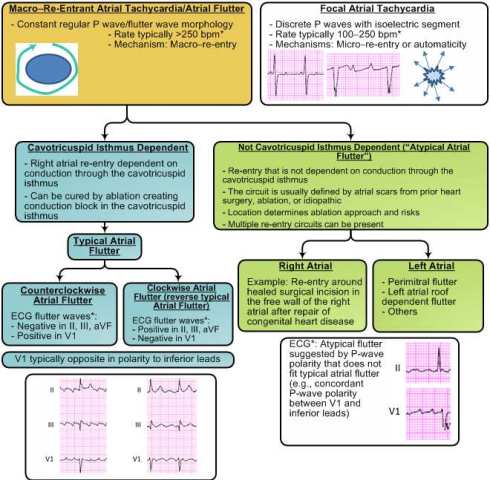
-
AF Types
Clinical Evaluation: Recommendation
Class I
- Electrocardiographic documentation is recommended to establish the diagnosis of AF. (Level of Evidence: C)
Rate control in AF
Class I
- Control of the ventricular rate using a beta blocker or nondihydropyridine calcium channel antagonist is recommended for patients with paroxysmal, persistent, or permanent AF (260-262). (Level of Evidence: B)
- Intravenous administration of a beta blocker or nondihydropyridine calcium channel blocker is recommended to slow the ventricular heart rate in the acute setting in patients without pre-excitation. In hemodynamically unstable patients, electrical cardioversion is indicated. (Level of Evidence: B)
- In patients who experience AF-related symptoms during activity, the adequacy of heart rate control should be assessed during exertion, adjusting pharmacological treatment as necessary to keep the ventricular rate within the physiological range. (Level of Evidence: C)
Class IIa
- A heart rate control (resting heart rate <80 bpm) strategy is reasonable for symptomatic management of AF. (Level of Evidence: B)
- Intravenous amiodarone can be useful for rate control in critically ill patients without preexcitation. (Level of Evidence: B)
Class IIb
- A lenient rate-control strategy (resting heart rate <110 bpm) may be reasonable as long as patients remain asymptomatic and LV systolic function is preserved. (Level of Evidence: B)
- Oral amiodarone may be useful for ventricular rate control when other measures are unsuccessful or contraindicated. (Level of Evidence: C)
Class III: Harm
- Nondihydropyridine calcium channel antagonists should not be used in patients with decompensated HF as these may lead to further hemodynamic compromise. (Level of Evidence: C)
- In patients with pre-excitation and AF, digoxin, nondihydropyridine calcium channel antagonists, or intravenous amiodarone should not be administered as they may increase the ventricular response and may result in ventricular fibrillation (274). (Level of Evidence: B)
Drugs
Beta blockers
- Metoprolol tartrate 2.5–5.0 mg IV bolus over 2 min; up to 3 doses 25–100 mg BID
- Atenolol 25–100 mg QD
- Esmolol 500 mcg/kg IV bolus over 1 min, then 50–300 mcg/kg/min IV
- Propranolol 1 mg IV over 1 min, up to 3 doses at 2 min intervals 10–40 mg TID or QID
- Nadolol 10–240 mg QD
- Carvedilol 3.125–25 mg BID
- Bisoprolol 2.5–10 mg QD
Nondihydropyridine calcium channel antagonists
- Verapamil (0.075-0.15 mg/kg) IV bolus over 2 min, may give an additional 10.0 mg after 30 min if no response, then 0.005 mg/kg/min infusion 180–480 mg QD (ER)
- Diltiazem 0.25 mg/kg IV bolus over 2 min, then 5-15 mg/h 120–360 mg QD (ER)
Digitalis glycosides
- Digoxin 0.25 mg IV with repeat dosing to a maximum of 1.5 mg over 24 h 0.125–0.25 mg QD
Others
- Amiodarone 300 mg IV over 1 h, then 10–50 mg/h over 24 h 100–200 mg QD
AF indicates atrial fibrillation; BID, twice daily; ER, extended release; IV, intravenous; N/A, not applicable; QD, once
daily; QID, four times a day; and TID, three times a day

-
Approach to Selecting Drug Therapy for Ventricular Rate Control
Rhythm Control
Electrical and Pharmacological Cardioversion of AF and Atrial Flutter
Thromboembolism Prevention: Recommendations
Class I
- For patients with AF or atrial flutter of 48-hour duration or longer, or when the duration of AF is unknown, anticoagulation with warfarin (INR 2.0 to 3.0) is recommended for at least 3 weeks prior to and 4 weeks after cardioversion, regardless of the CHA2DS2-VASc score and the method (electrical or pharmacological) used to restore sinus rhythm (313-316). (Level of Evidence: B)
- For patients with AF or atrial flutter of more than 48 hours or unknown duration that requires immediate cardioversion for hemodynamic instability, anticoagulation should be initiated as soon as possible and continued for at least 4 weeks after cardioversion unless contraindicated. (Level of Evidence: C)
- For patients with AF or atrial flutter of less than 48-hour duration and with high risk of stroke, intravenous heparin or LMWH, or administration of a factor Xa or direct thrombin inhibitor, is recommended as soon as possible before or immediately after cardioversion, followed by longterm anticoagulation therapy. (Level of Evidence: C)
- Following cardioversion for AF of any duration, the decision regarding long-term anticoagulation therapy should be based on the thromboembolic risk profile (Section 4). (Level of Evidence: C)
Direct-Current Cardioversion:
A number of technical factors influence cardioversion efficacy, including energy, waveform, and electrode placement. A biphasic waveform is more effective than a monophasic waveform. Anteroposterior electrode placement is superior to anterolateral placement in some but not all studies. If an attempt at cardioversion using 1 electrode placement fails, another attempt using the alternative placement is recommended. The initial use of a higher-energy shock is more effective and may minimize the number of
shocks required as well as the duration of sedation. The risks associated with cardioversion include thromboembolism, sedation-related complications, ventricular tachycardia and fibrillation, bradyarrhythmias, skin burn or irritation from electrodes, muscle soreness, and reprogramming or altering implanted cardiac device function. Elective cardioversion should not be performed in patients with evidence of digoxin toxicity, severe hypokalemia, or other electrolyte imbalances until these factors are corrected.
Recommendations
Class I
- In pursuing a rhythm-control strategy, cardioversion is recommended for patients with AF or atrial flutter as a method to restore sinus rhythm. If cardioversion is unsuccessful, repeated direct-current cardioversion attempts may be made after adjusting the location of the electrodes or applying pressure over the electrodes, or following administration of an antiarrhythmic medication (320). (Level of Evidence: B)
- Cardioversion is recommended when a rapid ventricular response to AF or atrial flutter does not respond promptly to pharmacological therapies and contributes to ongoing myocardial ischemia, hypotension, or HF. (Level of Evidence: C)
- Cardioversion is recommended for patients with AF or atrial flutter and pre-excitation when tachycardia is associated with hemodynamic instability. (Level of Evidence: C)
Pharmacological Cardioversion: Recommendations
Class I
- Flecainide, dofetilide, propafenone, and intravenous ibutilide are useful for pharmacological cardioversion of AF or atrial flutter provided contraindications to the selected drug are absent. (Level of Evidence: A)
Class IIa
- Administration of oral amiodarone is a reasonable option for pharmacological cardioversion of AF. (Level of Evidence: A)
- Propafenone or flecainide (“pill-in-the-pocket”) in addition to a beta blocker or nondihydropyridine calcium channel antagonist is reasonable to terminate AF outside the hospital once this treatment has been observed to be safe in a monitored setting for selected patients.(Level of Evidence: B)
Class III: Harm
- Dofetilide therapy should not be initiated out of hospital owing to the risk of excessive QT prolongation that can cause torsades de pointes. (Level of Evidence: B)
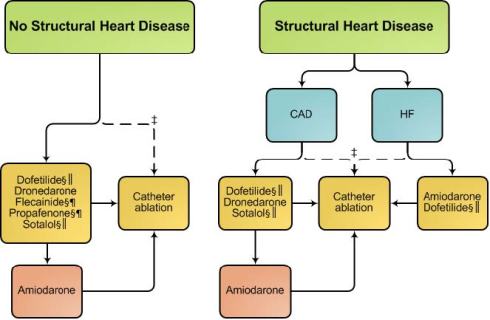
- Strategies for Rhythm Control in Patients with Paroxysmal and Persistent AF
AF Complicating ACS: Recommendations
Class I
- Urgent direct-current cardioversion of new-onset AF in the setting of ACS is recommended for patients with hemodynamic compromise, ongoing ischemia, or inadequate rate control. (Level of Evidence: C)
- Intravenous beta blockers are recommended to slow a rapid ventricular response to AF in patients with ACS who do not display HF, hemodynamic instability, or bronchospasm. (Level of Evidence: C)
Class IIb
- Administration of amiodarone or digoxin may be considered to slow a rapid ventricular response in patients with ACS and AF associated with severe LV dysfunction and HF or hemodynamic instability. (Level of Evidence: C)
- Administration of nondihydropyridine calcium antagonists might be considered to slow a rapid ventricular response in patients with ACS and AF only in the absence of significant HF or hemodynamic instability. (Level of Evidence: C)
Hyperthyroidism: Recommendations
Class I
- Beta blockers are recommended to control ventricular rate in patients with AF complicating thyrotoxicosis unless contraindicated. (Level of Evidence: C)
- In circumstances in which a beta blocker cannot be used, a nondihydropyridine calcium channel antagonist is recommended to control the ventricular rate. (Level of Evidence: C)
Pulmonary Disease: Recommendations
Class I
- A nondihydropyridine calcium channel antagonist is recommended to control the ventricular rate in patients with AF and chronic obstructive pulmonary disease. (Level of Evidence: C)
- Direct-current cardioversion should be attempted in patients with pulmonary disease who become hemodynamically unstable as a consequence of new onset AF. (Level of Evidence: C)
Pulmonary Disease: Recommendations
Class I
- A nondihydropyridine calcium channel antagonist is recommended to control the ventricular rate in patients with AF and chronic obstructive pulmonary disease. (Level of Evidence: C)
- Direct-current cardioversion should be attempted in patients with pulmonary disease who become hemodynamically unstable as a consequence of new onset AF. (Level of Evidence: C)
WPW and Pre-Excitation Syndromes: Recommendations
Class I
- Prompt direct-current cardioversion is recommended for patients with AF, WPW, and rapid ventricular response who are hemodynamically compromised (64). (Level of Evidence: C)2. Intravenous procainamide or ibutilide to restore sinus rhythm or slow the ventricular rate is recommended for patients with pre-excited AF and rapid ventricular response who are not hemodynamically compromised (64). (Level of Evidence: C)
- Catheter ablation of the accessory pathway is recommended in symptomatic patients with preexcited AF, especially if the accessory pathway has a short refractory period that allows rapid antegrade conduction (64). (Level of Evidence: C)
Class III: Harm
- Administration of intravenous amiodarone, adenosine, digoxin (oral or intravenous), or nondihydropyridine calcium channel antagonists (oral or intravenous) in patients with WPW syndrome who have pre-excited AF is potentially harmful as they accelerate the ventricular rate. (Level of Evidence: B)
Heart Failure: Recommendations
Class I
- Control of resting heart rate using either a beta blocker or a nondihydropyridine calcium channel antagonist is recommended for patients with persistent or permanent AF and compensated HF with preserved EF (HFpEF) (262). (Level of Evidence: B)
- In the absence of pre-excitation, intravenous beta blocker administration (or a nondihydropyridine calcium channel antagonist in patients with HFpEF) is recommended to slow the ventricular response to AF in the acute setting, with caution needed in patients with overt congestion, hypotension, or HF with reduced LVEF (496-499). (Level of Evidence: B)
- In the absence of pre-excitation, intravenous digoxin or amiodarone is recommended to control heart rate acutely in patients with HF (270, 497, 500, 501). (Level of Evidence: B)
- Assessment of heart rate control during exercise and adjustment of pharmacological treatment to keep the rate in the physiological range is useful in symptomatic patients during activity. (Level of Evidence: C)
- Digoxin is effective to control resting heart rate in patients with HF with reduced EF. (Level of Evidence: C)
Class IIa
- A combination of digoxin and a beta blocker (or a nondihydropyridine calcium channel antagonist for patients with HFpEF), is reasonable to control resting and exercise heart rate in patients with AF (260, 497). (Level of Evidence: B)
- It is reasonable to perform AV node ablation with ventricular pacing to control heart rate when pharmacological therapy is insufficient or not tolerated (262, 502, 503). (Level of Evidence: B)
- Intravenous amiodarone can be useful to control the heart rate in patients with AF when other measures are unsuccessful or contraindicated. (Level of Evidence: C)
- For patients with AF and rapid ventricular response causing or suspected of causing tachycardiainduced cardiomyopathy, it is reasonable to achieve rate control by either AV nodal blockade or a rhythm-control strategy (52, 300, 504). (Level of Evidence: B)
- For patients with chronic HF who remain symptomatic from AF despite a rate-control strategy, it is reasonable to use a rhythm-control strategy. (Level of Evidence: C)
Class IIb
- Oral amiodarone may be considered when resting and exercise heart rate cannot be adequately controlled using a beta blocker (or a nondihydropyridine calcium channel antagonist in patients with HFpEF) or digoxin, alone or in combination. (Level of Evidence: C)
- AV node ablation may be considered when the rate cannot be controlled and tachycardiamediated cardiomyopathy is suspected. (Level of Evidence: C)
Class III: Harm
- For rate control, intravenous nondihydropyridine calcium channel antagonists, intravenous beta blockers, and dronedarone should not be administered to patients with decompensated HF. (Level of Evidence: C)

0.000000
0.000000
Tag:atrial fibrillation, fibrillazione atriale, Guidelines, Linee guida








 MEDEST
DL vs VL. Can you see the differences?
25 AprTell us your experience about the two tecniques. We are interested in you impressions and suggestions.
Share your own experience and tips with other readers.
MEDEST will publish all the comments and will debate them with all his followers.
So fill the form below and start the discussion!
Il messaggio è stato inviato
Condividi:
Tag:contact-form