Archivio | advanced airway management RSS feed for this section

Confirming Tracheal Intubation: stop wasting your time!

2 Lug

Intro

The methods to confirm tracheal intubation (and exclude accidental oesophageal intubation) are classically divided in Techniques not requiring manual ventilation and Techniques requiring manual ventilation::

  1. Techniques not requiring manual ventilation
    • Inspection of the vocal cords: there should be visual confirm- ation that the tube lies surrounded by the glottic structures
    • Palpation of the trachea: an assistant palpating the external trachea may feel vibrations, corresponding to the tube passing the tracheal rings
    • Oesophageal detector device: Tracheal placement results in free aspiration of gas from the lungs; in oesophageal intubation, the walls of the oesophagus collapse around the tube lumen preventing gas flow
  2. Techniques requiring manual ventilation:
    • Sounds
    • Compliance: A ‘normal’ compliance during manual ventilation
    • Inspection of the chest: Good expansion of the chest on manual ventilation
    • Auscultation of the epigastrium
    • Auscultation of the chest
    • CO2 detection
      • Capnography – a normal capnogram for at least six breaths suggests tracheal intubation
      • Capnometry – a change in indicator to denote CO2 suggests tracheal intubation

Despite nowadays is evident that CO2 detection is the gold standard in terms of sensibility and specificity, our daily practice in managing airways still and strongly rely on clinical methods to confirm when the tube is correctly posed in the trachea and not in the oesophagus.

The article

Hansel, J., Law, J.A., Chrimes, N., Higgs, A. and Cook, T.M. (2023),

Clinical tests for confirming tracheal intubation or excluding oesophageal intubation: a diagnostic test accuracy systematic review and meta-analysis. Anaesthesia. https://doi.org/10.1111/anae.16059

In this meta-analysis the authors investigated the literature about the reliability of different methods to confirm tracheal intubation and exclude oesophageal intubation.

This is a clinically relevant point cause the unrecognised oesophageal intubation leads to catastrophic consequences on patients health.

Which Clinical test they evaluated:

How they presented the data

The false positive rate (FPR)

The FPR indicates how often any sign that is considered suggestive of successful tracheal intubation (for example chest rising or hearing breath sounds),might occur despite the tube is not in the trachea but in the oesophageal. Usually an acceptable number of FPR can be 0,1 (or the 10% (10 out of 100) of the total positive results) but you can understand how in this case, considered the high clinical relevance of the topic we have to reach for lower FPR the 1 out of 10.

The Likelihood Ratio (LR): positive (LR+) or negative (LR-)

The positive LR (LR+) indicates how many times is more probable that the tube is the trachea than in the oesophagus the investigated sign is present

A test with a LR+=10 (cut off value for reliability) means that there is 10 times more probability that the tube is really in the trachea than in the oesophagus

The negative LR (LR-) indicates how many times is more probable that the tube is the oesophagus han in the trachea if the investigated sign is present

A test with a LR- of 0.1 (cut off value for reliability) means that there is 1/10 times more probability that the tube is in the oesophagus than in the trachea.

What they found
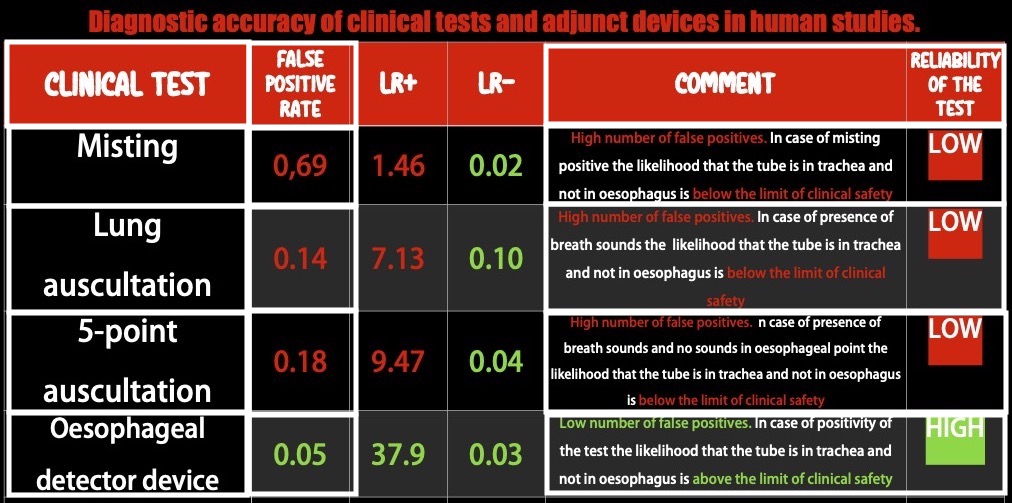
Conclusion

The available data strongly suggest that clinical signs lack the discriminatory power to exclude oesophageal intubation to a sufficient degree to ensure patient safety when capnography is not available or doubted. The oesophageal detector device performs better than clinical examination, and in resource-limited environments with no access to capnography, may be sufficiently sensitive and specific to help guide decision-making.

Clinical Practice Take Home Message

Based on the result of this study when available use waveform capnography to confirm tracheal intubation and exclude oesophageal intubation. Clinical tests can be dangerously misleading and potentially a waste of precious time in difficult environments as emergency prehospital setting.

In poor resources systems if any form of ETCO2 is not available, the most reliable test to confirm tracheal intubation is the Oesophageal detector device.

In case of oesophageal intubation

19 Ago

Just published Preventing unrecognised oesophageal intubation: a consensus guideline from the Project for Universal Management of Airways and international airway societies

Thanks to a prestigious panel of international authors. Great job and definitely solid indication about how to prevent and recognise accidental oesophageal intubation.

Just some of the key recommendations

  • Exhaled carbon dioxide monitoring and pulse oximetry should be available and used for all episodes of airway management.
  • Routine use of a videolaryngoscope is recommended whenever feasible.
  • Inability to detect sustained exhaled carbon dioxide requires oesophageal intubation to be actively excluded.
  • Tube removal should be undertaken if any of the following are true:
    • Oesophageal placement cannot be excluded
    • Sustained exhaled carbon dioxide cannot be restored
    • Oxygen saturation deteriorates at any point before restoring sustained exhaled carbon dioxide

Refer to the full text guidelines for more.
Here is the link to Safe Airway Society livestream event.
Must read, must follow. Free open access.

Let’s go outside

The following are personal considerations on peculiar aspects about management of accidental oesophageal intubation in prehospital environment and come from my personal clinical experience.

Beware they are just personal considerations and practical tricks and tips and are not intended to substitute the above guidelines. 

They are intended to suggest an alternative mental and technical approach when dealing with oesophageal intubation on uncontrolled patients in difficult environment.

Some general considerations

  1. Prehospital uncontrolled patients are not on empty stomach so are at high risk of regurgitation/inhalation
  2. Even few ventilation efforts in case of oesophageal intubation pone the patient at high risk of regurgitation/inhalation 
  3. Suctioning in prehospital setting is not always ready avalliate (mind your environment) or maximally performant (mind your equipment) 
  4. First attempt in prehospital setting must be always the best one. Think before trying a second attempt in case of failure. Implement your plan or change plan.
  5. Apply the Indication, Suitability, Feasibility approach while supporting oxygenation, ventilation and protection.

DO NOT REMOVE THE OT TUBE STRAIGHT FORWARD IN CASE OF ACCIDENTAL OESOPHAGEAL INTUBATION IN PREHOSPITAL ENVIRONMENT.

The way I like it. The way I do it.

  1. Live the “oesophageal” OT tube in (overcuffed) and if it’s possible apply a continuous suctioning to exclude the oesophagus and protect the airways 
  2. Place a SGA to restore oxygenation and ventilation (trough BMV or NIV)
  3. After restoring oxygenation (SaO2 >94%) and ventilation (EtCO2 40 mmHg) if suitable and feasible (see below) proceed to a second attempt of tracheal intubation (must be videolaryngoscope+bougie)
  4. If the second attempt succeeds remove the “oesophageal” OT
  5. If the second attempt is not suitable or feasible transport to nearest hospital (patient is well oxygenated and ventilated via SGA and protected via oesophageal exclusion) for further stabilisation (you can replace the oesophageal OT tube with a large bore oro-gastric tube or insert the orogastric tube trough the SGA dedicated channel)
  6. If you can’t restore oxygenation and ventilation via SGA or you can’t place a SGA remove the oesophageal OT tube and try to oxygenate and ventilate (remember patient is not protected) via BVM and NC (double oxygenation) 
  7. If even BVM fails declare CICO 
Suitability 
  • Do I have a plan to implement regarding the  first attempt
  • Can I improve my environment (Setting) moving the patient to a more comfortable place/position 
  • Is the time to nearest hospital short/long 
Feasibility 
  • Am I in the right mental mood after 1st attempt (me) to try a better second one
  • Is my team ready for a second attempt (team) 
  • Do I have the right equipment to implement my second attempt (Equipment)

The visual algorithm

The Video

By Mario Rugna
ALL Ohio EM

Supporting ALL Ohio EM Residencies in the #FOAMed World

Triggerlab

Let's try to make it simple

thinking critical care

a blog for thinking docs: blending good evidence, physiology, common sense, and applying it at the bedside!

urgentcareultrasound

More definitive diagnosis, better patient care

Critical Care Northampton

Reviewing Critical Care, Journals and FOAMed

OHCA research

Prehospital critical care for out-of-hospital cardiac arrest

SonoStuff

Education and entertainment for the ultrasound enthusiast

phemcast

A UK PREHOSPITAL PODCAST

First10EM

Emergency medicine - When minutes matter...

Songs or Stories

Sharing the Science and Art of Paediatric Anaesthesia

airwayNautics

"Live as if you will die tomorrow; Learn as if you will live forever"

resusNautics

Navigating resuscitation

The Collective

A Hive Mind for Prehospital and Retrieval Med

Dave on Airways

Thoughts and opinions on airways and resuscitation science

FOAMcast

A Free Open Access Medical Education Emergency Medicine Core Content Mash Up

Broome Docs

Rural Generalist Doctors Education

St.Emlyn's

Emergency Medicine #FOAMed

"CardioOnline"Basic and Advanced Cardiovascular medicine" Cariology" concepts and Review -Dr.Nabil Paktin,MD.FACC.دکتـور نبــــیل "پاکطــــین

این سایت را به آن دکتوران و محصلین طب که شب و روز برای رفاه نوع انسان فداکاری می کنند ، جوانی و لذایذ زندگی را بدون چشمداشت به امتیاز و نفرین و آفرین قربان خدمت به بشر می کنند و بار سنگین خدمت و اصلاح را بدوش می کشند ، اهداء می کنم This site is dedicated to all Doctors and students that aver the great responsibility of People’s well-being upon their shoulders and carry on their onerous task with utmost dedication and Devotionاولین سایت و ژورنال انتــرنتی علـــمی ،تخـصصی ، پــژوهشــی و آمــوزشــی طبـــی در افغــانســـتان

EmergencyPedia

Free Open Access Medical Education

Little Medic

Learning everything I can from everywhere I can. This is my little blog to keep track of new things medical, paramedical and pre-hospital from a student's perspective.

Prehospital Emergency Medicine Blog

All you want to know about prehospital emergency medicine

Italy Customized Tour Operator in Florence

Check out our updated blog posts at https://www.italycustomized.it/blog

GoogleFOAM/FOAMSearch

The FOAM Search Engine

EM Lyceum

where everything is up for debate . . .

Pediatric EM Morsels

Pediatric Emergency Medicine Education

AmboFOAM

Free Open Access Medical Education for Paramedics

Rural Doctors Net

useful resources for rural clinicians

Auckland HEMS

Unofficial site for prehospital care providers of the Auckland HEMS service

ECHOARTE

L'ECOGRAFIA: ENTROPIA DELL'IMMAGINE

MEDEST

Prehospital Emergency Medicine

EM Basic

Your Boot Camp Guide to Emergency Medicine

KI Doc

WE HAVE MOVED - VISIT WWW.KIDOCS.ORG FOR NEW CONTENT

Emergency Live

Prehospital Emergency Medicine

AMP EM

Academic Medicine Pearls in Emergency Medicine from THE Ohio State University Residency Program

Prehospital Emergency Medicine

 Academic Life in Emergency Medicine

Prehospital Emergency Medicine

Comments on: Homepage

Prehospital Emergency Medicine

Greater Sydney Area HEMS

The Pre-Hospital & Retrieval Medicine Team of NSW Ambulance