General considerations (dyspneic non infective patients)
Self Protection
The generic dyspneic patients do not pose any particular self protection issues above the general precautions
Clinical needs
Non infected dyspneic patient need moderately high FiO2 but considerately high oxygen flow rates.
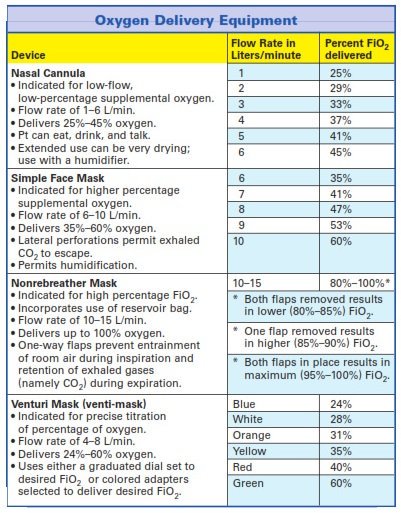
The available systems we have in this moment (at least on my operative setting) to deliver normally pressured O2 are:
Nasal cannula
Maximum gas flow 15 l/m
FiO2 variable between 25-45%
Simple face mask
Maximum gas flow 15 l/m
FiO2 variable between 40-60% at the mask level
Nonrebreather face mask (reservoir)
Maximum gas flow 15 l/m
FiO2 more 80-100%
Venturi mask
Gas flow between 40 to over 80 l/m
FiO2 titratable between 24% and 60%
To satisfy the increased minute ventilation of the highly dyspneic patient Venturi mask is the best device (high flow rate) and permits at the same time to tritrate the FiO2 based on the patients need avoiding indiscriminate hyperoxygenation.
Particular considerations in dyspneic potentially infective COVID-19 patients
Disclaimer
The following considerations derived from our initial experience on the field in suspect or confirmed COVID-19 with respiratory symptoms at their presentation or in the initial phases. Those are the majority of the patients we observed till the day this post was written.
The following considerations are not intended for all the severe hypoxic patients who definitively need early intubation and positive pressure ventilation.
Clinical needs
Those are dyspneic hypoxic patients who needs moderately high FiO2 and request more gas flow rates to satisfy increased minute ventilation.
So from an exclusively clinical point of view the best way to deliver oxygen it would be a Venturi mask.
Self Protection
In the actual situation in Italy the epidemiological geographical criteria is no more reliable to identify COVID-19 patients so any prehospital healthcare professional providing direct care to a dyspneic patient needs to be protected al least with:
Eye protection or Facial shield
Medical mask
Disposable gown
Disposable gloves
At the same time good practice is to reduce at minimum the number of direct caring providers, to maintain, if possible, a security distance > 1 mt, to invite any patient to wear, if tolerated, a surgical mask, and a pair of disposable gloves to minimise the risk of infection.
When providing direct care of dyspneic patients who needs O2 therapy the level of risk for droplet diffusion is generally increased cause of the presence of the gas flow.
All the available systems for oxygen delivery we mentioned above are open and allow a free exaltation of the patient in the surrounding area and potentially exposes all the healthcare caregivers to an increased risk of contamination cause of the augmented droplet dispersion and to a lack of protection.
Considerations
So when dealing with O2 therapy in the potentially infected patients we need to consider the relationship between risk of contamination and clinical efficacy of any device.
Nasal Cannula
Oxygenation –—+
Protection ++++
Nasal Cannula is the only device that permits the patient to wear a surgical mask on nose and mouth, decreasing droplet diffusion and protecting the healthcare team and at the same time maintains a certain clinical efficacy..
So my first approach is Nasal Cannula underneath a medical mask.
Utilising a different device than nasal cannula plus medical mask on the patient mouth and nose (simple, non rebreather or Venturi face mask) to deliver oxygen therapy all healthcare professionals need to be aware that the risk infection increases and the patient has no barriers and so they have to consider improving his own self protection level (N95, FPP2 mask at least)
Simple/Non rebreather Facial Mask
Oxygenation —++
Protection ++–
When you can’t reach a clinical acceptable SpO2 with nasal cannula we need to downgrade on our first goal (protection) to achieve a better clinical outcome.
Simple facial masks maintain a moderate protection form droplet spreading with a more clinical efficacy respect th the nasal cannula.
Nonrebreather facial mask either moderately protects against droplet diffusion with an improvement in FiO2 above simple face mask but the nonrebreather bag is a potential expirate gas reservoir potentially increasing the risk of spreading.
Venturi mask
Oxygenation -++++
Protection —-+
High flow titratable FiO2 in an open system mask can satisfy all minute ventilation needing guaranteeing Oxygenation at a cost of a great risk of spreading. My last choice in the scale of conventional Oxygen therapy.
References:
DSC Hui, MTV Chan, B Chow. Aerosol dispersion during various respiratory therapies: a risk assessment model of nosocomial infection to health care workers. Hong Kong Med J 2014;20(Suppl 4):S9-13
M. P. Wan , C. Y. H. Chao , Y. D. Ng , G. N. Sze To & W. C. Yu (2007) Dispersion of Expiratory Droplets in a General Hospital Ward with Ceiling Mixing Type Mechanical Ventilation System, Aerosol Science and Technology, 41:3, 244-258, DOI: 10.1080/02786820601146985
Shu-An Lee, Dong-Chir Hwang, He-Yi Li, Chieh-Fu Tsai, Chun-Wan Chen,and Jen-Kun Chen. Particle Size-Selective Assessment of Protection of European Standard FFP Respirators and Surgical Masks against Particles-Tested with Human Subjects. Journal of Healthcare Engineering. Volume 2016, Article ID 8572493, 12 pages
Thanks for reviewing and suggesting to: Scott Weingart, Jim DuCanto, Velia Marta Antonini, Giacomo Magagnotti, Andrea Paoliand all the other colleagues and friends who supported this post
Authors Conclusions: Following pre-hospital traumatic cardiac arrest, PEA on arrival portends death. Although Cardiac Wall Motion (CWM) is associated with survival to admission, it is not associated with meaningful survival. Heroic resuscitative measures may be unwarranted for PEA following pre-hospital traumatic arrest, regardless of CWM.
What kind of study is this?
A retrospective, cohort study consisting of adult trauma patients (n. 277 patients ≥18 years of age) admitted to one of two American College of Surgeons verified level 1 trauma centers in Maricopa County, Arizona within the same hospital system between February 2013 to September 2017 and January 2015 to December 2017.
Pre-hospital management by emergency medical transport services was guided by advanced life support protocols.
20 patients were identified on arrival to have had ROSC. 18 of these patients survived to hospital admission and 4 of them were discharged alive from hospital
147 patients were identified on arrival in asystole. Among these patients none were discharged alive from hospital.
The remaining 110 patients presented with PEA. 10 patients survived to admission, 9.1%, but only one, 0.9% was discharged from alive from hospital.
P-FAST was performed in 79 of the 110 patients with PEA (71.8%)
Presence of CWM was significantly associated with survival to hospital admission (2 but not to hospital discharge (zero with or without CWM).
Authors conclusions
Resuscitative efforts are unlikely to reverse the course of this pathophysiology, warranting sound clinical judgement from the treating physician concerning the decision to continue or desist, relative to mechanism of injury and clinical presentation.
CWM (signifying a beating heart and thereby pseudo PEA) was not associated with meaningful survival.
Nonetheless, we conclude that P-FAST is a useful tool for distinguishing PEA with cardiac standstill, which is in all likelihood terminal (and continued resuscitation would become an attempt at reanimation), versus pseudo PEA, whereby the heart is actually still beating, representative of a veritable sign of life, and ongoing resuscitative attempts may be considered appropriate despite the unfavorable prognosis.
My considerations on methodology and results
Conventional ACLS protocol, as performed in the study, IS NOT the standard of care in TCA.
No clinical intervention to address reversible causes where performed (or mentioned) in the field.
The only clinically oriented manoeuvre performed in the field was tracheal intubation in just half of the patients (52.0% of the patients were intubated).
Prehospital resuscitation time (20 minutes mean time) was spent performing non useful and potentially dangerous interventions (closed chest compressions, epinephrine administration) for TCA.
Patients with PEA and documented CWM (but not only them)at their arrival in ED has been hypo perfused during the entire pre-hospital resuscitation time and lost most of their chances for good clinical outcome.
So in my opinion this study and it’s conclusions are biased by a wrong approach to Traumatica Cardiac Arrest in the prehospital phase.
Emergency providers, when treating patients in traumatic cardiac arrest, need to perform interventions addressing the possible REVERSIBLE causes:
Exanguination/Massive Hemorrage (Pelvic Binding, TXA administration, Tourniquet or direct compression)
Hypoxia (Tracheal Intubation)
Tension Pneumo (Double Thoracostomy)
Hypovolemia (Blood or fluid resuscitation)
Emergency providers need to rely on direct (central pulse palpation, Ultrasuond) or indirect (EtCO2, Plethysmography) signs of perfusion to guide their clinical interventions.
Resuscitation of Traumatic Cardiac Arrest patients in not futile just need to be performed in the right way.
این سایت را به آن دکتوران و محصلین طب که شب و روز برای رفاه نوع انسان فداکاری می کنند ، جوانی و لذایذ زندگی را بدون چشمداشت به امتیاز و نفرین و آفرین قربان خدمت به بشر می کنند و بار سنگین خدمت و اصلاح را بدوش می کشند ، اهداء می کنم This site is dedicated to all Doctors and students that aver the great responsibility of People’s well-being upon their shoulders and carry on their onerous task with utmost dedication and Devotionاولین سایت و ژورنال انتــرنتی علـــمی ،تخـصصی ، پــژوهشــی و آمــوزشــی طبـــی در افغــانســـتان
Learning everything I can from everywhere I can. This is my little blog to keep track of new things medical, paramedical and pre-hospital from a student's perspective.
COVID-19 and O2 therapy. Initial prehospital approach in mild symptomatic patients.
16 MarGeneral considerations (dyspneic non infective patients)
Self Protection
The generic dyspneic patients do not pose any particular self protection issues above the general precautions
Clinical needs
Non infected dyspneic patient need moderately high FiO2 but considerately high oxygen flow rates.
The available systems we have in this moment (at least on my operative setting) to deliver normally pressured O2 are:
To satisfy the increased minute ventilation of the highly dyspneic patient Venturi mask is the best device (high flow rate) and permits at the same time to tritrate the FiO2 based on the patients need avoiding indiscriminate hyperoxygenation.
Particular considerations in dyspneic potentially infective COVID-19 patients
Disclaimer
The following considerations derived from our initial experience on the field in suspect or confirmed COVID-19 with respiratory symptoms at their presentation or in the initial phases. Those are the majority of the patients we observed till the day this post was written.
The following considerations are not intended for all the severe hypoxic patients who definitively need early intubation and positive pressure ventilation.
Clinical needs
Those are dyspneic hypoxic patients who needs moderately high FiO2 and request more gas flow rates to satisfy increased minute ventilation.
So from an exclusively clinical point of view the best way to deliver oxygen it would be a Venturi mask.
Self Protection
In the actual situation in Italy the epidemiological geographical criteria is no more reliable to identify COVID-19 patients so any prehospital healthcare professional providing direct care to a dyspneic patient needs to be protected al least with:
At the same time good practice is to reduce at minimum the number of direct caring providers, to maintain, if possible, a security distance > 1 mt, to invite any patient to wear, if tolerated, a surgical mask, and a pair of disposable gloves to minimise the risk of infection.
When providing direct care of dyspneic patients who needs O2 therapy the level of risk for droplet diffusion is generally increased cause of the presence of the gas flow.
All the available systems for oxygen delivery we mentioned above are open and allow a free exaltation of the patient in the surrounding area and potentially exposes all the healthcare caregivers to an increased risk of contamination cause of the augmented droplet dispersion and to a lack of protection.
Considerations
So when dealing with O2 therapy in the potentially infected patients we need to consider the relationship between risk of contamination and clinical efficacy of any device.
Nasal Cannula
Oxygenation –—+
Protection ++++
Nasal Cannula is the only device that permits the patient to wear a surgical mask on nose and mouth, decreasing droplet diffusion and protecting the healthcare team and at the same time maintains a certain clinical efficacy..
So my first approach is Nasal Cannula underneath a medical mask.
Utilising a different device than nasal cannula plus medical mask on the patient mouth and nose (simple, non rebreather or Venturi face mask) to deliver oxygen therapy all healthcare professionals need to be aware that the risk infection increases and the patient has no barriers and so they have to consider improving his own self protection level (N95, FPP2 mask at least)
Simple/Non rebreather Facial Mask
Oxygenation —++
Protection ++–
When you can’t reach a clinical acceptable SpO2 with nasal cannula we need to downgrade on our first goal (protection) to achieve a better clinical outcome.
Simple facial masks maintain a moderate protection form droplet spreading with a more clinical efficacy respect th the nasal cannula.
Nonrebreather facial mask either moderately protects against droplet diffusion with an improvement in FiO2 above simple face mask but the nonrebreather bag is a potential expirate gas reservoir potentially increasing the risk of spreading.
Venturi mask
Oxygenation -++++
Protection —-+
High flow titratable FiO2 in an open system mask can satisfy all minute ventilation needing guaranteeing Oxygenation at a cost of a great risk of spreading. My last choice in the scale of conventional Oxygen therapy.
References:
DSC Hui, MTV Chan, B Chow. Aerosol dispersion during various respiratory therapies: a risk assessment model of nosocomial infection to health care workers. Hong Kong Med J 2014;20(Suppl 4):S9-13
M. P. Wan , C. Y. H. Chao , Y. D. Ng , G. N. Sze To & W. C. Yu (2007) Dispersion of Expiratory Droplets in a General Hospital Ward with Ceiling Mixing Type Mechanical Ventilation System, Aerosol Science and Technology, 41:3, 244-258, DOI: 10.1080/02786820601146985
Shu-An Lee, Dong-Chir Hwang, He-Yi Li, Chieh-Fu Tsai, Chun-Wan Chen,and Jen-Kun Chen. Particle Size-Selective Assessment of Protection of
European Standard FFP Respirators and Surgical Masks against Particles-Tested with Human Subjects. Journal of Healthcare Engineering. Volume 2016, Article ID 8572493, 12 pages
Thanks for reviewing and suggesting to: Scott Weingart, Jim DuCanto, Velia Marta Antonini, Giacomo Magagnotti, Andrea Paoli and all the other colleagues and friends who supported this post
Condividi: