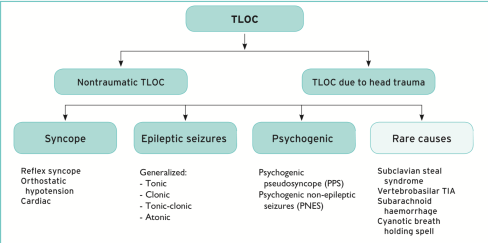
Non traumatic Transitory Lost Of Consciousness (TLOC) is a common cause of medical emergency call. Among TLOC Syncope is the most common cause. So the first challenge for an emergency professional is discerning from Syncope and non syncope situations (seizures, psychogenic, other rare causes).

2018 ESC Guidelines for the diagnosis and management of syncope
Syncope according to 2018 Guidelines definition is a “TLOC due to cerebral hypoperfusion, characterised by a rapid onset, short duration, and spontaneous complete recovery”.
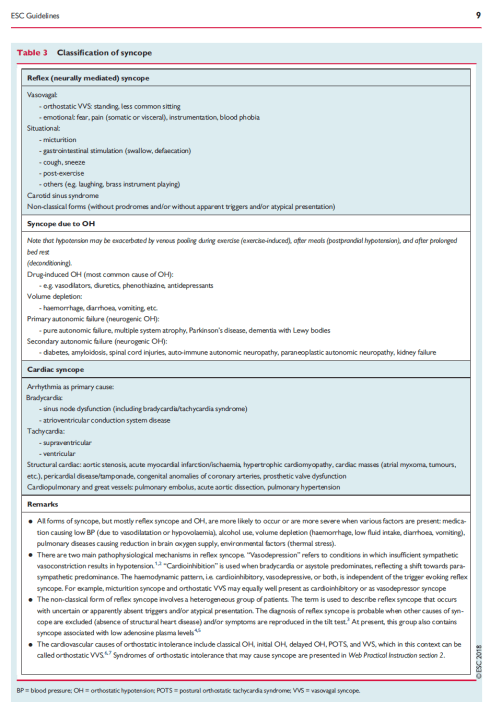
Among Syncope the causes can be found in vagal reflex (Reflex syncope), a drop in blood pressure due to a deficiency of compensation in a standing position (Orthostatic syncope) and a cardiac cause of syncope (Cardiac syncope)

2018 ESC Guidelines for the diagnosis and management of syncope
But what is the role and what can and must be done on the prehospital field to understand treat and risk stratify a Syncope?
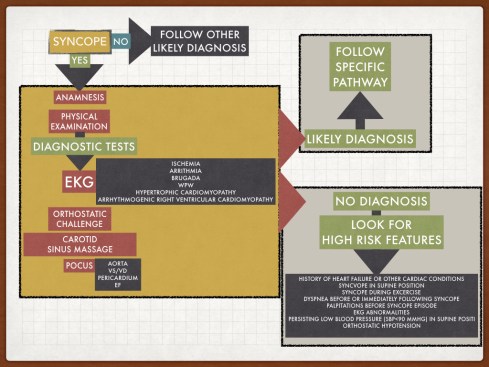
Anamnesis
Is a fundamental step to understand and risk stratify a syncope episode. It has to be targeted to collect all the important informations and to don’t loose precious time.
We can divide the information we collect in two categories.
The first kind of information we area going to ask (to bystanders and patients) is about the syncope event.
- How much the lost of consciousness lasted
- How it happened (standing, sitting or laying)
- What was the patient doing (resting or during exercise)
- What the patient felt before the syncope (palpitations, chest pain, dyspnea, dizziness, other)
- What happened during or immediately after the syncope (seizures, other)
Second step is collecting informations about the patient medical conditions. We have to focus on
- What medical condition he actually suffers or suffered in the past
- Which kind of drugs he is actually doing
After a focus anamnesis the second step is about the physical exam of the patient.
Diagnostic tests
During physical exam a rapid general neurologic and cardiac examination has to be completed, but two additional steps need to be done in a syncope patients
- Orthostatic challenge in active standin position
- Carotid sinus massage (CSM) in patients aged >40 years.
Orthostatic challenge: Standing BP evaluation has to be done after 3 minutes of active standing position with the patient fully monitored, and “abnormal BP fall is defined as a progressive and sustained fall in systolic BP from baseline value >_20 mmHg or diastolic BP >_10 mmHg, or a decrease in systolic BP to <90 mmHg” (European Society of Cardiology 2018 ESC Guidelines for the diagnosis and management of syncope).
Carotid sinus massage: A ventricular pause lasting >3 s and/or a fall in systolic BP of >50mmHg is known as carotid sinus hypersensitivity. “Carotid sinus syndrome (CSS) There is strong consensus that the diagnosis of CSS requires both the reproduction of spontaneous symptoms during CSM and clinical features of spontaneous syncope compatible with a reflex mechanism.” (European Society of Cardiology 2018 ESC Guidelines for the diagnosis and management of syncope)
12 leads EKG
It’s a fundamental diagnostic tool and has to be performed in all syncope patients.
What are the risky features we have to consider when looking to ann EKG of a syncope patients:
At least 6:
- Ischemia
- Arrithmia
- Pre-excitation/WPW
- Brugada pattern
- Hypertrophic cardiomyopathy
- Arrhythmogenic Right Ventricular Cardiomyopathy
POCUS
Is there a role for Point of Care Ultrasound in differential diagnosis and risk stratification of syncope.
Probably yes cause we can look at:
- Aorta for dissection
- VD/VS ratio for PE
- Pericardium for effusion
- EF for cardiac function evaluation
High risk VS non high risk syncope
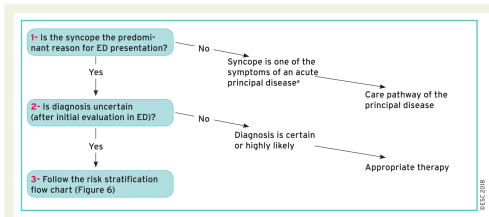
At the end of those steps the prehospital professional has two chances.
- There is a likely cause of syncope
- The syncope is of unknown cause

2018 ESC Guidelines for the diagnosis and management of syncope
If the cause is known or very likely we have to follow the specific pathway.
In the unknown syncope we have to stratify the risk.
In prehospital field is important to look for high risk features of syncope:
- History of heart failure or other cardiac conditions
- Syncvope in supine position
- Syncope during excercise
- Dyspnea before or immediately following syncope
- Palpitations before syncope episode
- EKG abnormalities
- Persisting low blood pressure (SBP<90 mmHg) in supine positi
- Orthostatic Hypotension
Each one of those is indicative of high risk prehospital features and the patient need further ED examination.
In all other cases the clinician can decide case by case if the patient can be treated out of the hospital or need admission to ED.

References :


Do we really need Lights and Sirens when transporting a patient?
16 AprFor who has a multiyear experience in prehospital emergency medicine and deals everyday with emergency transportation of critical patients the sensation is that the use of emergency warning systems are, mostly of times, useless and doesn’t really have any impact on clinical outcomes.
But beyond any subjective thought, do we have any evidence on that?
My analysis starts from this article published in 2018 on Annals of Emergency Medicine
by Brooke L. Watanabe, MD et al. and entitled “Is Use of Warning Lights and Sirens Associated With Increased Risk of Ambulance Crashes? A Contemporary Analysis Using National EMS Information System (NEMSIS) Data”. The authors conclusion says that “Ambulance use of lights and sirens is associated with increased risk of ambulance crashes. The association is greatest during the transport phase. EMS providers should weigh these risks against any potential time savings associated with lights and sirens use.“
Curbside to Beside blog published an interesting post about this topic and resumed the data in this incredibly intuitive infographic
Data extrapolated from
Wantabe et al. (2018)
While ambulances crash rate when using L&S (light and sirens) in the response phase is slightly increased (7.0 vs 5.4) in the transportation phase the amount of crashes associated with L&S use is significatively higher (17.1 vs 7.0).
So L&S transportation increases the odd of crash (and this is intuitive) but, on the other side, is there any evidence that use of L&S increases response time and improve clinical outcome?
Fast is Time????
Fabrice Dami et al in an article entitled “Use of lights and siren: is there room for improvement?” found that the time saved with L&S transport was 1.75 min (105 s; P<0.001) in day time and 0.17 min (10.2 s; P=0.27) night-time.
So evidently fast is time, but is a gain of less than 2 min a clinical significative time?
Time is Life???
In 2010 in the article “Emergency Medical Services Intervals and Survival in Trauma:Assessment of the “Golden Hour” in a North AmericanProspective Cohort” concluded that “there was no association between EMS intervals and mortality among injured patients with physiologic abnormality in the field”.
Anderson et al in a 2014 article “Preventable deaths following emergency medical dispatch – an audit study” demonstrated how just 0,2% of the 94.488 “non L&S” dispatched emergencies died in the first 24 hours from the call. Of those just 0.02% of total “non L&S” emergencies were considered “potentially preventable if the dispatcher had assessed the call as more urgent and this had led to an ambulance dispatch with a shorter response time and possible rendezvous with a physician-staffed mobile emergency care unit”
So mostly of the emergencies are not time sensitive and the clinical outcome does not differ if the transport time is shorter.
Take home messages for our system and for clinical practice
Maybe we need lights and sirens in response phase, cause slightly increase in accident risk corresponds to some gain in arriving time on the scene.
Maybe we don’t need lights and sirens in transportation phase cause a great increase in risk of crash do not correspond to a clinical sensitive time gain.
For sure when using L&S we need to be aware that the risk doesn’t worth the price, and even if we use L&S in the varies phases of emergencies pushing the threshold of security too forward increases the risks and don’t improve clinical benefits for the transported patients.
Clinicians need to be more concerned about performing the right procedures to stabilise patients on pre-hospital phase more than hurrying with unstable patients toward an unreal Eldorado and risking their own and patients lives.

Condividi: