Eco-ALS and mechanical chest compressions: that’s the way I like to run a code!

29 Mag

47 ysr old male collapsed on the field. First ALS unit found him arrested in VF.
Shocked 3 times he regained a palpable central pulse.
When we arrived the patient arrested again. VF on the monitor. Shocked 4 times. Mechanical chest compression and tracheal intubation on board. He received Epi, Amio (300+150), Calcium Gluconate and Bicarb (suspected iper K in kidney insufficiency) before the ROSC.
15 minutes passed from the collapse to ROSC,  7 of wich were of “no flow” (no chest compressions, no AED from bystanders).
PMH: Hypertension, kidney insufficiency, heavy smokers. Medication history unknown.
He had chest pain before collapsing, as referred from bystanders.

Vitals at ROSC: GCS 3 T, RR 10 MV, SaO2 100%, EtCO2 35,  HR 70 bpm. NIBP 100/70 12 lead EKG at ROSC is shown below

ROSC IMA

An echo of the heart performed on the field (in the ambulance running to the ED, so I apologize for the low quality of the images) confirmed the lateral wall MI and shown distended IVC, B lines in both lungs and no sign of aortic dissection. No free fluid was present in the abdomen.

After administration of Heparin and Aspirin the patient arrived in ED and taken straight to cat-lab where a PTCA was performed 50 min after the collapse.

I think that increasing the use of ultrasonography on the field, and using it when really makes the difference, with a Point Of Care approach, is a big step for the care of critical patients out of the hospital.

Every prehospital emergency system have to instruct their professionals on how to use POC Ultra Sonography on the field and need specific “problem solving” protocols to help it’s diffusion.

MEDEST you tube


HEMS vs GEMS. By ground or by air: which is the best way to take care of traumatized patients

1 Mag
Amb vs HEMS22 years old male hit from a car on the roadside of an urban area.
The ground EMS ambulance (physician, nurse staffed), dispatched on scene, find the patient alert, oriented and spontaneously breathing. His vitals are:
GCS 15 , RR 20, SaO2 95, HR 85, SBP 110
No mention of head trauma.
Chest no sign of trauma, bilateral and equal expansion and air entry.
Pulse is strong.
He has a profound laceration with loss of substance but not evisceration on left flank and no external bleeding from the wound.
The abdomen is painful and resistant to palpation in left flank.
There is an open fracture to left tibia (VNS 9).
The ground team, after the primary survey, activates the local medical helicopter.
The place is 10 k from a level 1 Trauma Center on a local road in an urban area and the helicopter is at 10 minutes flight distance. There is a safe landing space at 500 mt from the point of the accident.
A Level 2 hospital (general surgery, orthopedics, anesthesiologist, radiology and laboratory 24/7) is at 2 km distance from the scene.
Is this a proper activation for HEMS?
What international litterature says about advantages of air medical service vs ground medical service?
 

So what about the case?
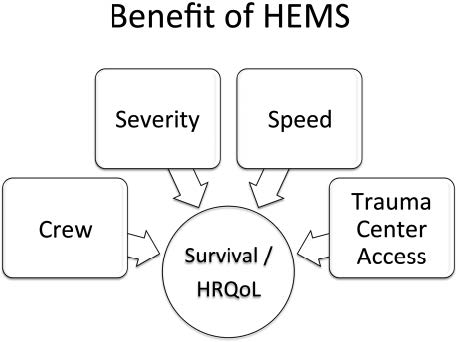
Comparative effectiveness of helicopter emergency medical services compared to ground emergency medical services


Severity: The patient is slightly tachycardic, and the mechanism of trauma give us some clue on possible abdominal injuries, so he need a quick transport to an hospital with a general surgery (and orthopedics naturally for the tibial fracture)
Speed: non simultaneous activation. This kind of missions become competitive on long distances (45 miles) from Level 1 Trauma center (or the appropriate hospital). So GEMS is faster anyway.
Trauma center access: no difference between HEMS and GEMS and even there is doubt on the fact that this patient really need a Level 1 Trauma Center
Crew: this patient does not need an over skilled staff for some particular procedure.
We can conclude that for the standard HEMS activation criteria, this is not an appropriate activation and the best way to reach the hospital for this patient is a ground ambulance.
Any suggestion on the theme treated is, as usual, very welcome


Logo MEDEST2


Canadian Association of Emergency Physicians Position Statement on Acute Ischemic Stroke

12 Apr

CJEM CJO masthead9Has been published in March 2015 on Canadian Journal of Emergency Medicine (CJEM), the Canadian Association of Emergency Physicians Position Statement on Acute Ischemic Stroke.

Let’s see what they say about thrombolitic therapy and administration timing.

  • THROMBOLYTIC THERAPY WITHIN 3 HOURS OF STROKE SYMPTOM ONSET

Summary of Evidence

Seven trials either specifically addressed the efficacy of rt-PA in stroke within three hours of symptom onset or provided data on a subgroup of patients receiving therapy within three hours of symptom onset.
Fibrinolytic therapy administered within three hours of symptom onset increases the probability of survival with a favourable neurologic outcome (NNT 10).
This favourable effect appears to be independent of age, including patients aged 80 and older.
Pooled data from several clinical trials suggest an important relationship between time from symptom onset to treatment and outcome. Patients treated with rt-PA within 90 minutes to symptom onset were more likely to have a favourable neurologic outcome compared to those treated from 90 – 180 minutes to treatment onset.


Recommendations

1. Patients with acute ischemic stroke whose neuroimaging excludes contraindications, and who can be treated within three hours of symptom onset, should be offered rt-PA with the goal of improving functional outcome (STRONG RECOMMENDATION, HIGH QUALITY EVIDENCE)
2. Stroke patients meeting eligibility criteria for thrombolytic therapy should be treated as rapidly as possible, with a target door-to-needle time of less than 60 minutes (STRONG RECOMMENDATION, MODERATE QUALITY EVIDENCE)
3. Due to limited resources and practical constraints, the administration of thrombolytic therapy within 3 hours in rural hospital may not be feasible and hence not recommended in all of these settings but should fall to the discretion of the local decision making team (WEAK RECOMMENDATION, LOW QUALITY EVIDENCE)
 
Logo MEDEST2

MEDEST COMMENT:

The statement is fair enough. The 3 hrs time window, even with the controversy that all the 7 available studies evidenced, is pretty condivisible. I love the great emphasis on ” target door-to-needle time of less than 60 minutes” that has to be the real target of all Emergency Systems. Is also well thought the flexibility on rural hospital and the assumption that treatment in those situations is discretional. Very well done i feel to subscribe everything!
 

CJEM CJO masthead9

  • THROMBOLYTIC THERAPY WITHIN 3—4.5 HOURS OF STROKE SYMPTOM ONSET

Summary of Evidence

A pooled analysis of all trials involving acute ischemic stroke patients treated in the 3.0 to 4.5 hour time window was published by Emberson et al. in 2014. Combing data from 7 studies that included 2768 patients, the likelihood of a favorable outcome was higher if patients were randomized to rt-PA. (Emberson J, Lees KR, Lyden P, et al; for the StrokeThrombolysis Trialists’ Collaborative Group. Effect of treatment delay, age, and stroke severity on the effects of intravenous thrombolysis with alteplase for acute ischaemic stroke: a meta-analysis of individual patient data from randomised trials. Lancet 2014;384(9958):1929-35)(.……) the latter figure (of the meta-analysis) showing significant imprecision and no difference in mortality, but a direction of effect towards a mortality increase with rt-PA in a dose-response relationship between time to treatment and 90-day mortality, suggesting a potential for increased mortality in those treated beyond 3 hours.
Included in this most recent systematic review is patient-level data from the IST-3 trial.

IST-3 suggested a 7-fold increase in symptomatic ICH associated with thrombolytic use (7% vs. 1%) as well as an expected increase in early mortality but no difference in disability or mortality at 6 months for those treated at 3–4.5 hours.


Recommendations

1. Thrombolytic therapy for acute ischemic stroke patients should not be routinely offered for the treatment of acute ischemic stroke for patients if administered beyond three hours of stroke symptom onset (WEAK RECOMMENDATION, MODERATE QUALITY EVIDENCE).
2. The administration of thrombolytic therapy for acute ischemic stroke beyond 3 hours from stroke symptom onset should be restricted to specialized stroke centers with advanced imaging capabilities or as part of a research protocol (WEAK RECOMMENDATION, LOW QUALITY EVIDENCE).
Logo MEDEST2

 MEDEST COMMENT:

Even for this part of the statement my agreement is total.
IST 3 that is, at the moment, the largest study on thrombolytic therapy for ischemic stroke is a total contradiction in terms of evidence about benefit and major bleeding events.
Good outcome in the first 3 hrs, a majority of adverse events between 3 and 4,5 hrs and again beneficial between 4,5 and 6 hrs. Just one consideration: the results are not suitable for clinical practice.
So Thrombolytic therapy for acute ischemic stroke patients should not be routinely offered for the treatment of acute ischemic stroke for patients if administered beyond three hours of stroke symptom onset.

This is in contrast with the 2013 AHA/ASA Guidelines for the Early Management of Patients With Acute Ischemic Stroke that states:

Intravenous rtPA (0.9 mg/kg, maximum dose 90 mg) is recommended for administration to eligible patients who can be treated in the time period of 3 to 4.5 hours after stroke onset (Class I; Level of Evidence B). The eligibility criteria for treatment in this time period are similar to those for people treated at earlier time periods within 3 hours, with the following additional exclusion criteria: patients >80 years old, those taking oral anticoagulants regardless of INR, those with a baseline NIHSS score >25, those with imaging evidence of ischemic injury involving more than one third of the MCA territory, or those with a history of both stroke and diabetes mellitus.

Bottom line:

I really like this Statement and think that is one of best available policy  about thrombolytic therapy and ischemic stroke.

References:

Logo MEDEST2


Cricoid Pressure in DAS 2015 Intubation Guidelines: an update.

10 Apr

Below you can read the answer to my question (Cricoid pressure in new DAS (Difficult Airway Society) Guidelines: still on?) from Chris Frerk, Chair of DAS guidelines group:

logo1


“Mario

Thanks for your thoughtful comments

The website posting is necessarily brief and there will be more detail in the developing paper.

Your point is well made re cricoid pressure vs BURP and external laryngeal manipulation.

The paper is predominantly aimed at anaesthesia for surgery in the UK though we recognise that the existing 2004 guidelines are referred to in ED and ITU settings. Current UK practice does endorse cricoid pressure for RSI (which includes most ED intubations) though we are aware this is not the case in other countries – we’ve taken the stance so far that this paper isn’t the place to debate RSI techniques but we do have a developing section on RSI.

 I think we do need to be more explicit about when cricoid pressure would be expected to be applied – we are already clear in the paper  that if it is applied and laryngoscopy is difficult the pressure should be removed (with suction at hand). In the elective scenario (with no cricoid pressure) then we say BURP / external laryngeal pressure (different from cricoid pressure) should be tried to see if view improves.

The group meet again soon and we’ll be discussing your thoughts in more detail then.

Thanks for taking the time to contribute”

Chris Frerk

Chair of DAS guidelines group

Now is only a matter of time.
We wait for the release of the new DAS Guidelines on intubation and, as Chris anticipated, on RSI.

Stay tuned on MEDEST and all the FOAMED community to be up to date on this and all the news from the Emergency Medicine World

Logo MEDEST2

Cricoid pressure in new DAS (Difficult Airway Society) Guidelines: still on?

9 Apr

DAS Difficult Airway Society

Background story:

This is the post I wrote about the DAS April 2015 draft on intubation Guidelines:

DAS (Difficult Airway Society) released a draft of its intubating Guidelines for evaluation and comment before definitive update.

Previuos 2007 Guidelines are available here DAS Intubation Guidelines

This is the link to download the Update (April 2015) on DAS intubation guidelines 2015

What’s new on this draft:

Plan A (face mask ventilation and intubation)

  • Preoxygeneation is now included (to mantain even during the intubation, O2 nasal cannula).
  • VL is considered as standard approach (same leve than DL).
  • Cricoid pressure is no longer mentioned and replaced with BURP.
  • BURP has to be released if difficult intubation(laryngoscopy is predicted.

The authors invite all to send suggestions and comments to intubation@das.uk.com.

Last night (Italy time at least) on Twitter a debate about the presence on less of cricoid pressure aroused:

23:06 @MyEmergencyMed: Difficult Airway Society 2015
 intubating Guidelines http://t.co/3I82OaQEhV vía
 @MEDEST118
 23:12 @MDaware: cc @ketaminh MT @MyEmergencyMed: DAS
 2015 intubating Guidelines http://t.co/qmIQLonSTQ vía
 @MEDEST118

https://twitter.com/MDaware/status/585897954936025089

23:13 @ketaminh: @MDaware @MyEmergencyMed
 @MEDEST118 have u checked original source
 material…editor?
 23:13 @MDaware: @ketaminh @MyEmergencyMed
 @MEDEST118 nope in a meeting
23:18 @ketaminh: @MDaware @MyEmergencyMed
 @MEDEST118 ok let me help you then
 http://t.co/T2MiXq28dA
 23:22 @MDaware: @ketaminh @myemergencymed @medest118
 interestingly the guidelines say "Remove cricoid
 pressure" — not use it! http://t.co/3mAGwKRKoj
 23:23 @ketaminh: @MDaware @MyEmergencyMed
 @MEDEST118 stick to social media, editor! cricoid
 pressure still advocated by DAS as far as I can tell .
 remove prn
 23:29 @ketaminh: @MDaware @MyEmergencyMed
 @MEDEST118 well…you have to use it if you are to
 remove it

So let’s see what the released material from DAS says about cricoid pressure?

On the algorithm:

DAS2015_04b_draft_Page_3

And then on the Highlights:

DAS2015_04b_draft.001

Pretty controversial.

So let’s ask directly to DAS wich is their position on cricoid pressure.

Screen Shot 2015-04-09 at 09.41.06And let’s wait for their answer.

Stay in touch!

Logo MEDEST2

Difficult Airway Society 2015 intubating Guidelines

6 Apr

DAS Difficult Airway Society

DAS (Difficult Airway Society) released a draft of its intubating Guidelines for evaluation and comment before definitive update.

Previuos 2007 Guidelines are available here DAS Intubation Guidelines

This is the link to download the Update (April 2015) on DAS intubation guidelines 2015

What’s new on this draft:

Plan A (face mask ventilation and intubation)

  • Preoxygeneation is now included (to mantain even during the intubation, O2 nasal cannula).
  • VL is considered as standard approach (same leve than DL).
  • Cricoid pressure is no longer mentioned and replaced with BURP.
  • BURP has to be released if difficult intubation(laryngoscopy is predicted.

Plan B (Oxygenation/ventilation with Supraglottic Airway Devices)

  • ILMA is no longer mentioned as preferred device
  • 2nd generation SAD is suggested as default devices

Plan C (Think and revert to face mask oxygenation/ventilation before surgical approach)

  • No main changes
  • Focus on reverting neuromuscolar blockade action

Plan D (surgical approach)

  • Scalpel Bougie Tube (finger????) technique suggested as standard approach
  • Cannula techniques only for skilled operators

The authors invite all to send suggestions and comments to intubation@das.uk.com.

Logo MEDEST2

VL tecnique in suspect intracranial bleeding

31 Mar

62 yrs old male found unconscious GCS 6 (E1,V1, P4). Sign of vomiting and inhalation. Profoundly hypoxic, hypertensive (BP 200 over 110). Pupils were miotic with anisocoria dx>sx.

The team, after aspiration of gastric material from the airway, decided for airway control, before transport. The patient is overweight with a “taurine” neck so VL was chosen as first choice for airway management.

RSI (Fentanyl. Midazolam, Sux) performed. In the video you can see a detailed explanation of the VL technique that is slightly different from DL technique.

 Post-intubation management included ventilation optimization (EtCO2 35-38 mmHg in suspected intracranial hypertension) oxygenation and haemodynamic management.

Logo MEDEST2


A Day in Milan

16 Mar

Not just Emergency Medicine! If you planned to visit Italy for the great EXPO follow this amazing Blog.
Linda Sorgiovanni guide you through the most exciting travel experience.
Food, wine, art and much more from real italian culture.
Don’t miss it!

Avatar di lindasorgiovanniItaly Customized Tour Operator in Florence

With the expo just around the corner all eyes on on Milan. Typically known as the business hub of Italy not as romantic or as charming as its famous neighbours to visit.  Although Milan is actually a fabulous city to visit with historical and contemporary charm and probably the best restaurants in the entire country!

I was there a couple of weeks ago to meet up with our friends and collaborators. Heres is how I spent my day:
Just a short ride from Florence on Italo to arrive at the Porta Garibaldi Train Station a short walk over the road to Feltrinelli Cafe and Book Shop in Piazza Sigmund Fraud. This business district is known as Centro Direzione situated north west of the city centre.  After our cappuccino and introduction in to the business district we took a cab in the historical centre for lunch at L’Arte  an exceptional restaurant…

View original post 346 altre parole

RSI Basics Podcast with Minh Le Cong (@ketaminh on twitter)

16 Mar

Avatar di jrparameddscotDOWNSTAIRS CARE OUT THERE BLOG

A Podcast with Minh Le Cong on beginner RSI. Recorded for my own personal reference but its such a great resource for Paramedics, Paramedic Students and a good all round touch up on the subject with a person much more knowledgeable than I.

pharm-logo-1400x1400
If your not listening to Minh I highly suggest you start! His podcast was my first step into #FOAMed, so its an absolute honor to have him on my own.

You can find the Podcast over on I-Tunes:  https://itunes.apple.com/au/podcast/downstairs-care-outthere-podcast/id876296199c (please take time to leave a review or rating!!)

Below you will find some of the papers, trial and websites that we mention throughout, all are a good read. There’s also a number of different checklist ideas.

PHARM Podcast 61:
http://prehospitalmed.com/2013/02/19/pharm-podcast-61-rapid-sequence-intubation/

The Original RSII Article;

http://journals.lww.com/anesthesia-analgesia/Citation/1970/07000/Rapid_Induction_Intubation_for_Prevention_of.27.aspx

The study protocol for the Head Injury Retrieval Trial (HIRT): a single centre randomised controlled trial of physician prehospital management of severe…

View original post 51 altre parole

Let’s be clear! Not all trauma patients must be treated with spinal immobilization during prehospital resuscitation and transport.

9 Mar

ems-backboardsSpinal immobilization is performed in all trauma patients from the rescuers in EMS systems all over the world, regardless the mechanism of injury and the clinical signs.
This kind of approach is nowadays been rebutted from the recents evidences and the actual guidelines.
ACEP, in Jan 2015, released a policy statement entitled :”EMS Management of Patients with Potential Spinal Injury” clarifying the right indications, and contraindications, for spinal immobilization in prehospital setting.
The lack of evidence of beneficial use of devices such as spinal backboards, cervical collars etc… is in contrast with the demonstrated detrimental effects of such instruments: airway compromise, respiratory impairment, aspiration, tissue ischemia,increased intracranial pressure, and pain, consequent to spinal immobilization tools, can result in increased use of diagnostic imaging and mortality.

Already in 2009 a Cochrane review demonstrated the lack of evidences on use of spinal restriction strategies in trauma.

Recently the out of hospital validation of Nexus criteria and Canadian C-spine rules, strongly driven to a revisited approach to spinal immobilization.

So in 2013 American Association of Neurological Surgeons and the Congress of Neurological Surgeons Guidelines for the Management of Acute Cervical Spine and Spinal Cord Injurie”  and Faculty of Pre-Hospital Care “Pre-hospital Spinal Immobilisation: An Initial Consensus Statement” stated those changes.

Based on this statements:

  1. Spinal immobilization should not be used for patients with penetrating trauma without evidence of spinal injury.
  2. Spinal immobilization should be considered in all trauma patients with a cervical spine or spinal cord injury or with a mechanism of injury having the potential to cause cervical spinal injury.
  3. Spinal motion restriction should not be considered for patients with plausible blunt mechanism of injury and any of the following:
    • The patient is GCS 15 (normal lev el of alertness)
    • There is no posterior mid-line tenderness
    • There is no distracting injury (other painful injury)
    • There is no focal neurological signs and /or symptoms (e.g., numbness and/or motor weakness)
    • There is no anatomic deformity of the spine
    • There is no intoxication (alcohol or drugs, including iatrogenic)
  4. The long spinal board is an extrication device solely.
  5. Backboards should not be used as a therapeutic intervention or as a precautionary measure either inside or outside the hospital or for inter-facility transfers. For this purpose, a scoop stretch or vacuum mattress should be used.
  6. EMS providers ahs to be properly educated on assessing risk for spinal injury and neurologic assessment, as well as on performing patient movement in a manner that limits additional spinal movement in patients with potential spinal injury.

References

  1. 2015 ACEP Policy statements: EMS Management of Patients with Potential Spinal Injury
  2. Totten VY, Sugarman DB. Respiratory effects of spinal immobilization. Prehosp Emerg Care. Oct-Dec 1999;3(4):347-352.
  3. Cochrane Rewiev Spinal immobilisation for trauma patients
  4. Test performance of the individual NEXUS low-risk clinical screening criteria for cervical spine injury.
  5. The Out-of-Hospital Validation of the Canadian C-Spine Rule by Paramedics
  6. Evaluation of the Safety of C-Spine Clearance by Paramedics
  7. 2013 American Association of Neurological Surgeons and the Congress of Neurological Surgeons Guidelines for the Management of Acute Cervical Spine and Spinal Cord Injurie
  8. Faculty of Pre-Hospital Care “Pre-hospital Spinal Immobilisation: An Initial Consensus Statement”

Logo MEDEST2

ALL Ohio EM

Supporting ALL Ohio EM Residencies in the #FOAMed World

Triggerlab

Let's try to make it simple

thinking critical care

a blog for thinking docs: blending good evidence, physiology, common sense, and applying it at the bedside!

urgentcareultrasound

More definitive diagnosis, better patient care

Critical Care Northampton

Reviewing Critical Care, Journals and FOAMed

OHCA research

Prehospital critical care for out-of-hospital cardiac arrest

SonoStuff

Education and entertainment for the ultrasound enthusiast

phemcast

A UK PREHOSPITAL PODCAST

First10EM

Emergency medicine - When minutes matter...

Songs or Stories

Sharing the Science and Art of Paediatric Anaesthesia

airwayNautics

"Live as if you will die tomorrow; Learn as if you will live forever"

resusNautics

Navigating resuscitation

The Collective

A Hive Mind for Prehospital and Retrieval Med

Dave on Airways

Thoughts and opinions on airways and resuscitation science

FOAMcast

A Free Open Access Medical Education Emergency Medicine Core Content Mash Up

Broome Docs

Rural Generalist Doctors Education

St.Emlyn's

Emergency Medicine #FOAMed

"CardioOnline"Basic and Advanced Cardiovascular medicine" Cariology" concepts and Review -Dr.Nabil Paktin,MD.FACC.دکتـور نبــــیل "پاکطــــین

این سایت را به آن دکتوران و محصلین طب که شب و روز برای رفاه نوع انسان فداکاری می کنند ، جوانی و لذایذ زندگی را بدون چشمداشت به امتیاز و نفرین و آفرین قربان خدمت به بشر می کنند و بار سنگین خدمت و اصلاح را بدوش می کشند ، اهداء می کنم This site is dedicated to all Doctors and students that aver the great responsibility of People’s well-being upon their shoulders and carry on their onerous task with utmost dedication and Devotionاولین سایت و ژورنال انتــرنتی علـــمی ،تخـصصی ، پــژوهشــی و آمــوزشــی طبـــی در افغــانســـتان

EmergencyPedia

Free Open Access Medical Education

Little Medic

Learning everything I can from everywhere I can. This is my little blog to keep track of new things medical, paramedical and pre-hospital from a student's perspective.

Prehospital Emergency Medicine Blog

All you want to know about prehospital emergency medicine

Italy Customized Tour Operator in Florence

Check out our updated blog posts at https://www.italycustomized.it/blog

GoogleFOAM/FOAMSearch

The FOAM Search Engine

EM Lyceum

where everything is up for debate . . .

Pediatric EM Morsels

Pediatric Emergency Medicine Education

AmboFOAM

Free Open Access Medical Education for Paramedics

Rural Doctors Net

useful resources for rural clinicians

Auckland HEMS

Unofficial site for prehospital care providers of the Auckland HEMS service

ECHOARTE

L'ECOGRAFIA: ENTROPIA DELL'IMMAGINE

MEDEST

Prehospital Emergency Medicine

EM Basic

Your Boot Camp Guide to Emergency Medicine

KI Doc

WE HAVE MOVED - VISIT WWW.KIDOCS.ORG FOR NEW CONTENT

Emergency Live

Prehospital Emergency Medicine

AMP EM

Academic Medicine Pearls in Emergency Medicine from THE Ohio State University Residency Program

Prehospital Emergency Medicine

 Academic Life in Emergency Medicine

Prehospital Emergency Medicine

Comments on: Homepage

Prehospital Emergency Medicine

Greater Sydney Area HEMS

The Pre-Hospital & Retrieval Medicine Team of NSW Ambulance