Yesterday the usual MEDEST letterature review was almost fully pointed on Morphine use in ACS. The cited articles talked about Morphine use and survival outcome or P2Y12 inhibitors absorption. The latest evidence pointed toward less survival and less PY12 absorption when Morphine is administered in patients that suffered of ACS.
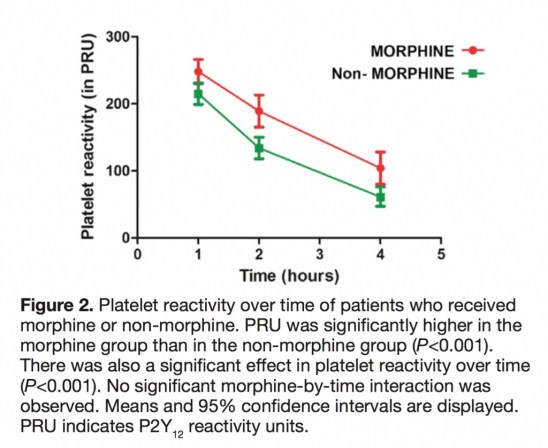
First evidences about those effects can be dated to CRUSADE(1) study, but more recently other studies pointed in this direction (2,3, 4).
And what about using Fentanyl instead? Some authors compared Morphine to Fentanyl (4) finding no evidences about the superiority of one on another, and on a recent study (5) Fentanyl carried the same detrimental effect on Ticagrelor absorption.

So we really have to ban Morphine or Opiates in ACS?
In an interesting post (6) Rory Spiegel questioned about the basic assumption that P2Y12 benefits in ACS was never really proven and so, even if P2Y12 inhibition by Morphine was real, no damages derived from Opiates effects on them.
On the other hand Vince di Giulio on EMS 12 leads (7) criticised the methodology of most studies at the basis of the P2Y12 inhibition and detrimental effect on survival.
Are you enough confused? What you really do and what all of this matter for daily clinical practice?
In the meantime you decide this is my personal clinical behaviour on opiates and ACS.
- In general I limit Opiates use in ACS only when pain is really a problem for patients(VNS>7) and it was not relieved by NTS.
- I’m more concerned about emodynamic profile of opiates so I prefer Fentanyl over Morphine cause is more stable, has a better pharmacological profile and induce less histamine release.
Read more about this topic. Explore the References:
- Meine TJ, Roe MT, Chen AY, Patel MR, Washam JB, Ohman EM, Peacock WF, Pollack CV Jr, Gibler WB, Peterson ED; CRUSADE Investigators. Association of intravenous morphine use and outcomes in acute coronary syndromes: results from the CRUSADE Quality Improvement Initiative. Am Heart J. 2005 Jun;149(6):1043-9. doi: 10.1016/j.ahj.2005.02.010. PMID: 15976786.
- Parodi G et al. Morphine is Associated with a Delayed Activity of Oral Antiplatelet Agents in Patients with ST-Elevation Acute Myocardial Infarction Undergoing Primary Percutaneous Coronary Intervention. Circ Cardiovasc Interv. 2014. PMID: 25552565
- Puymirat E et al. Correlates of Pre-Hospital Morphine Use in ST-Elevation Myocardial Infartion Patients and its Association with In-Hospital Outcomes and Long-Term Mortality: The FAST-MI (French Registry of Acute ST-Hobl EL et al. Morphine Interaction with Prasugrel: A Double-Blind Cross-Over Trial in Healthy Volunteers. Clin Res Cardiol. 2016. PMCID: PMC4805697Elevation and Non-ST-Elevation Myocardial Infarction) Programme. Eur Heart J 2016. PMID: 26578201
- Hobl EL et al. Morphine Interaction with Prasugrel: A Double-Blind Cross-Over Trial in Healthy Volunteers. Clin Res Cardiol. 2016. PMCID: PMC4805697
- McEvoy JW, Ibrahim K, Kickler TS, Clarke WA, Hasan RK, Czarny MJ, Keramati AR, Goli RR, Gratton TP, Brinker JA, Chacko M, Hwang CW, Johnston PV, Miller JM, Trost JC, Herzog WR, Blumenthal RS, Thiemann DR, Resar JR, Schulman SP. Effect of Intravenous Fentanyl on Ticagrelor Absorption and Platelet Inhibition Among Patients Undergoing Percutaneous Coronary Intervention: The PACIFY Randomized Clinical Trial. Circulation. 2018 Jan 16;137(3):307-309. Epub 2017 Oct 18. doi: 10.1161/CIRCULATIONAHA.117.031678. PMID: 29046319.
- Weldon ER et al. Comparison of Fentanyl and Morphine in the Prehospital Treatment of Ischemic Type Chest Pain. Prehosp Emerg Care 2016. PMID: 26727338
- Rory Spiegel at EM NERD (EMCrit): The Case of the Inconsequential Truth
- In defense of Morphine part 1
- In defense of Morphine part 2


 MEDEST
Fall and Rise of Morphine in ACS.
26 FebYesterday the usual MEDEST letterature review was almost fully pointed on Morphine use in ACS. The cited articles talked about Morphine use and survival outcome or P2Y12 inhibitors absorption. The latest evidence pointed toward less survival and less PY12 absorption when Morphine is administered in patients that suffered of ACS.
First evidences about those effects can be dated to CRUSADE(1) study, but more recently other studies pointed in this direction (2,3, 4).
And what about using Fentanyl instead? Some authors compared Morphine to Fentanyl (4) finding no evidences about the superiority of one on another, and on a recent study (5) Fentanyl carried the same detrimental effect on Ticagrelor absorption.
So we really have to ban Morphine or Opiates in ACS?
In an interesting post (6) Rory Spiegel questioned about the basic assumption that P2Y12 benefits in ACS was never really proven and so, even if P2Y12 inhibition by Morphine was real, no damages derived from Opiates effects on them.
On the other hand Vince di Giulio on EMS 12 leads (7) criticised the methodology of most studies at the basis of the P2Y12 inhibition and detrimental effect on survival.
Are you enough confused? What you really do and what all of this matter for daily clinical practice?
In the meantime you decide this is my personal clinical behaviour on opiates and ACS.
Read more about this topic. Explore the References:
Share this:
Related